Showing posts with label open ended. Show all posts

Tuesday, June 10, 2014

Stop Motion Animation Shorts

Creating with Technology

Our district has recently implemented a mobile 1:1 program. This means that all of our students will have access to technology both in school and at home through the use of school provided mobile devices with 3G.  The students are highly engaged in learning how to use their devices in new ways.  I am highly interested in offering a 21st century curriculum  by encouraging students to collaborate with each other to solve creative problems using technology as a creative tool.


Planning camera angles
Filming in progress
Experimenting

First, we just played. I think it's important to give the students an opportunity to experiment with the media they will be using in depth later. It's also a nice hook. We experimented with several movie making apps and made little movies about scissors moving across the table or pencils disappearing into their hands. Students were encouraged to explore free apps that they could find and to settle on one that worked best for them (that also had a share feature).


Practicing Skills

Some students used the school provided Android based phones (stop motion lite)  and while others used their personal iPads or iPhones (gorrillacam and iMovie) to explore movie making apps. We practiced saving and sharing our work via Google Drive.


Experimenting with ideas
Investigating 

Next, we dissected the qualities of good stop motion animation via several You Tube clips ranging from very amateur to professional. The students developed an understanding of how character development, story, camera angles, frames per second and a stationary camera can impact the quality of a stop motion movie. Blendspace link to all of the clips


Collaborating and Building Community

Testing the background
The students divided into teams and developed plans for their movies. No minimum length was given. No parameters for content were set. The goal was to make a film that could tell a story, any type of genre would do and any method of character development would be accepted. As a first project with a new group of mixed 6th - 8th grade students, this learning experience was as much about building community as it was about building movie making and technology skills.


Building characters
Open Ended Problems

I purposely did not tie a theme to their work or require a specific meaning making target as I was interested in what they would choose to do if given free reign of subject. I am always searching for what is meaningful to my students. I want them to think and behave as artists do. Setting a meaning making target or theme will help do this.  Sometimes though, (like for this problem) I like to intentionally step back and just observe where they are at and notice their interests.


Students collaboratively developed storyboards and made props. They did not seem to struggle with developing ideas and many noticed how having a team to collaborate with really helped.


Groups wrote love stories, adventure themes, reenactments from films they have seen or books they have read and some were screen versions of characters the students had previously developed through their own creative writing. Of course, as expected there were the ever popular epic battle scenes, some groups tried to defy the laws of nature and some were just plain silly. My role in this creative problem finding/solving adventure became materials facilitator, collaboration coach and tech consult. 


While I see the value in inviting students to have full creative license in their story production, I think that next time I will close the problem just a little bit and offer a range of four or five themes for them to choose from. When editing the works together, the final product would be more cohesive if they could be grouped in this way. I'm leaning towards the themes of transformation, growth, community and interdependence.


Inventing

Students made their movies from a wide variety of materials. Each group chose among many things including  paper, modeling clay, toys, cardboard, tools,whiteboards with Expo markers and some groups used their own bodies.  


One of the challenges that many of the groups had in making their films involved finding ways to keep the camera still.  The three tripods our media center had to loan only worked for flip cameras. The kids became pretty inventive, taping their phones and iPads to upside down stool legs and using binder clips attached to books and other things to keep their shots consistent.


When I try this again with a new group, I will invite the students to spend more class time investigating the benefits and limitations of each of the material choices. We may even spend a few days making more "practice" videos with each of the material options. I also hope to find some grant money for some movie making materials, including a set of ten or twelve tripods.


Making "fireworks"
Sharing an Experience
The students finished their very short animations in time to be edited together (thanks Jim!) into one large production.  This feature was premiered prior to an annual after school art event called the "Trashion Show" that I will post about soon.
The students were completely engrossed watching their own movies on the big screen for the first time. You could have heard a pin drop.
Reflecting

The students reflected upon the success of their films and the process of collaborating with others. We talked about how essential collaboration is to the creative process. They wrote and/or recorded "words of advice" for future classes who will also experiment with making stop motion animation films.  Some of their "words of advice":


"It's good to work with your friends, it can be easy when they help come up with ideas, but sometimes hard too. You have to learn to deal with problems together."


"Being creative and making movies is fun, but it's also a lot of work. If you try to do your best and work hard, you can surprise yourself."


"Make sure you take lots and lots of frames per second, otherwise your movie will be choppy and too fast."


"Be sure to save your work a lot. And always have a back up plan if your first idea doesn't look as good as you thought."


"Decide who will be in charge of the camera and who will move the stuff around. Keep your phone still or else your movie will look like there's something wrong with it."


"Use your time well.  Don't think you can wait until the last minute because you can't."


Below are three of my favorite student made movies. I hope you enjoy them as much as my students and I do!


Thursday, January 2, 2014

Using Science Fiction to Teach Creative Thinking, Part Three: SteamPunk

Part Three: SteamPunk and Learning to Step Back


Neverwas haul, photo courtesy of hanttula.com


SteamPunk is a sub genre of science fiction that is primarily focused on the creation of an alternate history with Victorian era/ Western Themed / Mechanized gadgetry.  The style features "retro-futurstic" works that are primarily steam powered. 


Hanging out at the MAEA SteamPunk gala with
former student teacher and art ed buddy, Michelle
The 2013 Michigan Art Education Association conference held at the Grand Hotel on Mackinac Island's theme was the "Grand Vision" and decked out in SteamPunk finery. 

There are lots of resources online about SteamPunk and even conventions where people can connect and celebrate their creativity in this theme.  


Learning to step back:

As an art teacher, we find ourselves in a dilemma when we stumble across fun art styles that inspire us.  We get "tunnel vision" and a grand idea in our heads about all of the cool things our kids could do with the theme that's inspired us.  I think it's natural for us to do, we're creative people.  In my early teaching days and not too distant past, I have been guilty of asking my students to make Impressionist or Aboriginal or Monochromatic "Blue Period" style paintings, Louise Nevelson boxes or Alexander Calder mobiles.  And just like getting excited about Chuck Close's fingerprint portraits I used to have my high school kids make, learning about SteamPunk got me thinking of all of the cool gears and watchfaces I could get my hands on for students to incorporate into jewelry or something equally cool, like maybe they could all make SteamPunk glasses like my friend Michelle is wearing in this photo.

Looking at my practice critically however, it's important to ask myself, "Where is the line that is crossed when the art or creative thinking our students are making/doing is ours (or someone else's) and it becomes no longer the students?"


How do you encourage creative thinking and creative invention/discovery if we ask our students to create work in the theme of ___________ (whatever the teacher has become inspired by, in this case, in the theme of SteamPunk).   How can I have my students learn about an art movement or art style and not have them be copiers of a style or of another artists' ideas?  I posed this challenge to myself: How can I accomplish these two goals:  A. Introduce students to this cool science fiction style of art making.  B. How "hands off" can I be in designing a lesson so that my students maintain the role of being the most creative people in the classroom and not just following through with an idea I have?

This is what we did.


1.  I showed them lots of examples of really cool SteamPunk Art work.  We looked at videos, people making costumes, tons of sculptures and mechanized SteamPunk toys, jewelry, and we even watched a little of the Tim Burton animated movie "9".   The lesson timing lined up with a field trip for all sixth graders to visit ArtPrize (an international art competition held annually in downtown Grand Rapids, MI) where many of the submitted works were SteamPunk in design. Every year there are more than a few works made by local artists who are skilled at welding and animatronics. The kids were excitedly pointing out to their non art class friends all of the SteamPunk features they could identify.

2. We gathered materials for mixed media assemblage sculptures.  We asked for broken appliances, tech trash, broken down computers and printers, nuts and bolts and random scrap from garages and foundries.  We got a lot of really bizarre stuff, which was cool.

Learning how to use tools properly.

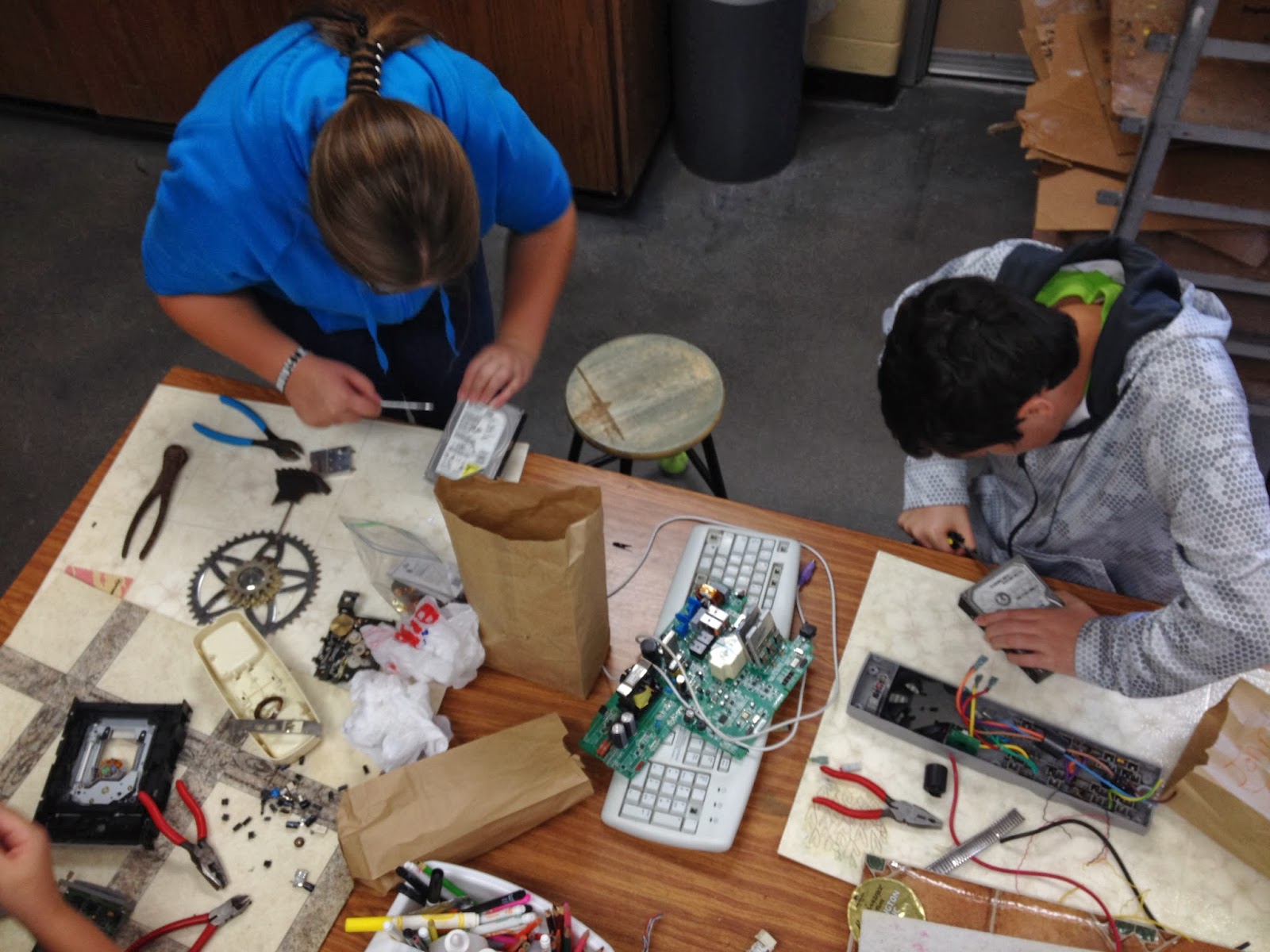
Figuring out how to take stuff apart.


Sharing treasures. 

Collaborating and building on each others creative ideas.


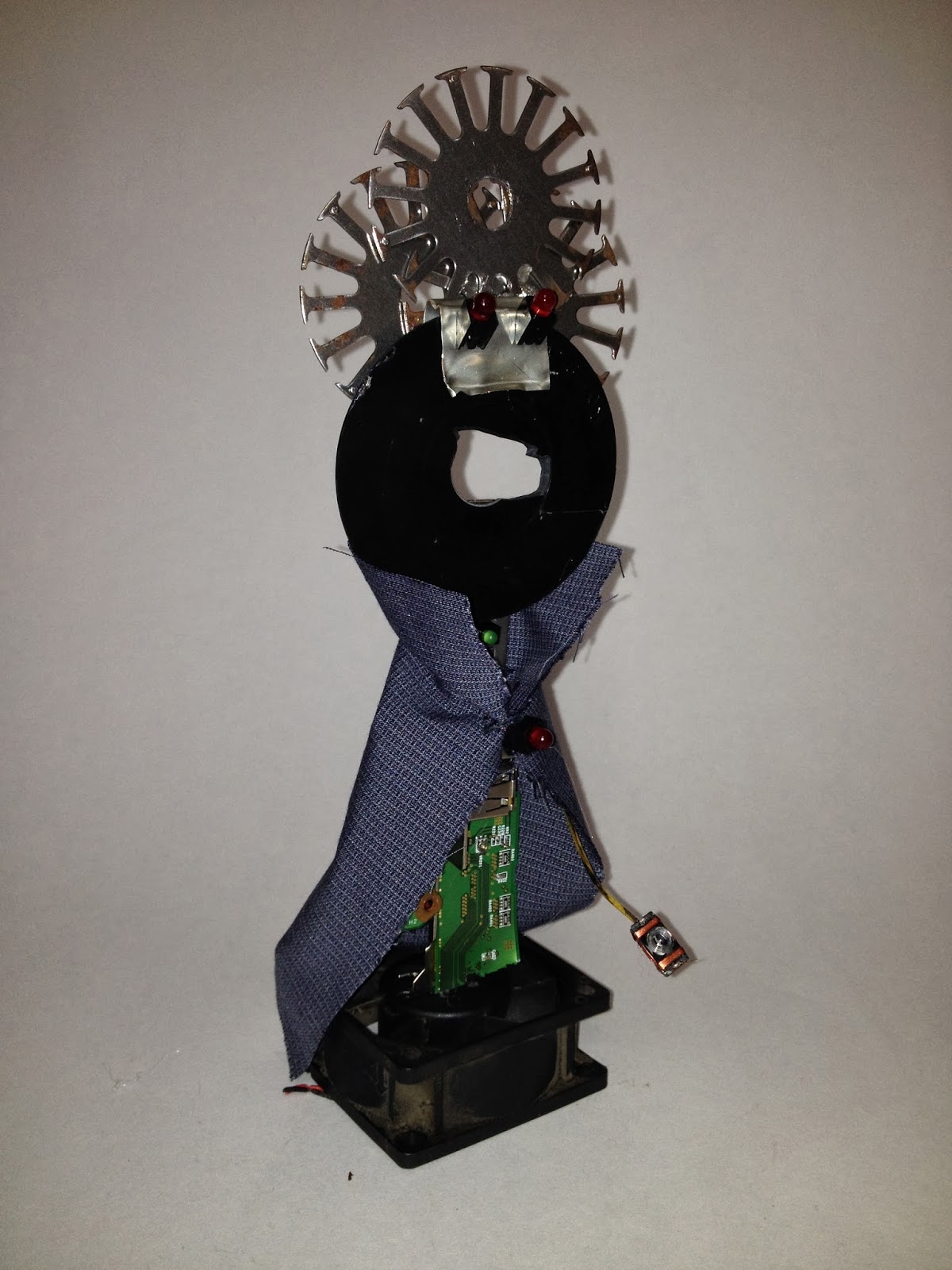
3.  The students were given the following directions:   Take some stuff apart.  See what's on the inside, how does it work?  Make something from what you've destroyed. Make sure it's interesting enough that you are proud of it. Make it with care. How can you put things together without showing how they are attached or the attachment is part of the design? Go.

I did not ask them to make something specifically SteamPunk inspired, on purpose. You can still see the SteamPunk influences showing up in some of their work.

Retro-futuristic fashion

Policeman in a warehouse

Hot Air Balloon


Jeremy

Headband of the future

SteamPunk spider (that actually crawls!)

The students had a few different gauges of wire, hot glue guns and dollar store tools at their disposal.
With laminate floor samples to cover/protect the tables, they got to work disassembling and exploring stuff.  Some students chose to work alone, many chose to collaborate.  Aside from the sound of destruction, you could have heard a pin drop they were so engaged.

Key to my heart

Robo turtle


Hypnotic Photographer

Harold

Robo butterfly

Super kitty


4. At the end of the week students named their work and wrote reflections on what they learned about the creation process and the Steam Punk movement.  Note: they were not asked to  write about how their work was "Steam Punk". They did happen to draw some parallels naturally though. The students set up a mini- gallery around the room and we talked about the ideas and experiences that each artist had during this discovery lesson.

Tiara with Laser

Reginald and Franklin, best friends


Time eternal

Roberto

PaintBot


Because I did not say to them "Make something that looks like SteamPunk." or "Make a robot" or "Make a sculpture that does ________", there was a very wide variety of student responses.  Learning to step back and let go of your vision allows room for the students vision to develop.

Sunday, November 24, 2013

25 little things to cultivate a creative art room culture

It can happen.  If you set up the culture of your classroom just right and if you make sure all of the kids needs are being met, you CAN keep a class full of 30+ middle schoolers with a variety of needs fully engaged and excited about learning and creating.  A must see visual featuring five levels of engagement put out by educationaltechnology.com has been floating around facebook this week.  If you haven't seen it yet, click on the link above.  I thought I would spend a little time this week writing about the everyday little things I do that add up to create a creative HIGHLY ENGAGED culture in my middle level classroom.


  1. Create and post everywhere a stress-free classroom motto like, "You are not here to prove yourself, you're here to improve yourself." Talk about it.
  2. Tell your students, "Only you know the right answer". Make them discover their own solutions to problems. Have them use you as a coach and not the "end all be all" source of knowledge.
  3. Have your students free write often to sort out ideas, but do not require them to show you everything that they write.  Respect their confidentiality and soon they will feel safe to share on their own.
  4. Model creative behaviors. Share the creative ideas of others. Tell your students when and how they have inspired you!
  5. Don't sit behind your desk. Get up and circulate, talk about the weekend, tell a funny story, be a real person to your students.
  6. Help your students find their own passion. Share your passions with them.
  7. Offer lots of opportunities for students to work collaboratively or independently as they choose.
  8. Say "Yes!  How can I help you get started?" when students approach you about doing something different as an alternative to the assignment. If they are seeking alternatives, that means they are thinking! I have never been let down by a student who wanted to take something in their own direction. It's about letting go of some control.
  9. Do your best to remove barriers to creativity. In the middle grades especially, the fear of not being able to make something look right can really deter some great ideas.  Students (and adults) will often choose an easier or less creative idea if it means they don't have to struggle with making something look exactly right. Occasionally allow students to skip over technical skill development in order to achieve creative meaning in their work. (Collage is one method, I'll write about others in a future post.)
  10. Encourage wierdness, silliness, play good music that everyone likes, dance and sing and make a fool of yourself from time to time.  Creativity dies in a sterile environment.
  11. Give your students "tools" to work with. Doing something without care is meaningless. Let them choose which tools they need for each job.  Occasionally, pull a student aside and give them the "special" drawing pencil or "super expensive" :)  drawing paper and see what they do with it.
  12. Give them informal opportunities to become experts with a particular media and allow them to teach you or another student something they discovered.
  13. Even if you don't feel the most confident with technology, offer technological options for your assignments. I learn so much from my students this way and they love showing me new things.
  14. Don't ask or tell your students to do their work, invite them to experience.
  15. Consider what personally engages and excites you as an artist or creative person. Think of ways this can translate into your classroom.  Don't put your kids through those boring foundations lessons you suffered through in your undergrad program.  Find better ways to teach boring things. If it's not enjoyable, why do it?
  16. Require students to respond differently from each other.
  17. Tie everything you can into their everyday experience and provide new experiences for them too. Ask them how their work relates to their life.
  18. Everyone likes to learn, our brains are hardwired for it. The trick is to make sure that you are teaching something that is new.  How many times do you think a middle school kid has made an artwork about "line" since they started school?  They get it, "a line can be straight, jagged, curvy or implied".  So what?  What have you learned that's new to you?  If it's new to you, you are likely to be inspired, share that with them instead. I bet they end up using "line" in their work.
  19. Be funny, truly care for each child, look for opportunities for growth, put in the extra time whenever possible and most importantly, you must love your (work?).
  20. Begin each class with a creative warm up that encourages off beat thinking and is not skill based. Offer opportunities to share the silly responses daily on the projector. It helps build class community. (watch for prompts in a future post)
  21. Challenge your students to know more than you know. It's ok not to know everything. Consider yourself a student in the presence of many teachers.
  22. Introduce your students to new ways of thinking by asking good questions, with starters like "What if..., When can..., How might...., Why doesn't..., Who does... ?"
  23. Provide opportunities for students to share and respond to each others work constructively both formally and informally. You should model appropriate comments as a guide.
  24. Keep working on an idea until you are excited about every part that you will teach. If you are not excited, how can you expect your students to be?
  25. Have high expectations for yourself and your students, you will all rise to meet them. 

Please share more ideas in the comments section of this post!  Have a great week!

Sunday, November 3, 2013

Changing my job description


Ask any art teacher why they think their class is important and I'd bet most of them would mention among other things that their class teaches students to be more creative.  But let’s look at our practices critically. 

As an art teacher, do you actually teach kids how to be more creative? Is painting a color wheel a creative act? Is painting a copy of a famous artwork creative? What if it's a monochromatic self portrait? Is making a coil pot a creative act? Our are students more creative after having done these exercises? How much of your curriculum do you devote to skill based lessons? How much do you devote to critical thinking and creative ideation?

If you know my history as an art teacher, and I'm guessing if you are reading this, you do, you know I've gone through some changes in the way I teach.  I entered the profession in the usual way. I went to college and learned how to get good grades by by mimicing whatever style of art work my college teachers  made.  I was trained in DBAE (Discipline Based Art Education) and was well versed in all things a good art teacher should know about how to construct a solid lesson.  I know how to make a lesson that could rival the content knowledge of any other subject area in school. It should be rigorous with Art Production, Art History, Art Criticism and Aesthetics.  Lessons also are encouraged to be multi-disciplinary in nature, have a reading and writing component and include a "multi-cultural" angle.  

Whew!  But I could do it with the best of them.  If there was a "right way" to do something, I was going to do it!  Looking back at some of the things I had my students do (with all of the best intentions) I make myself cringe.  My elementary students made very beautiful copies of Van Gogh's Starry Night in oil pastels, high school students made spectacular large scale fingerprint portrait of themselves ala Chuck Close and my middle schoolers made fantastic color wheel versions of famous paintings. And at the end of the marking period, semester or school year, I would have a decent handful of these masterpieces tossed into the trashcan by their creator without care as they walked out the door.

When I applied for a Masters in Art Education Degree at the Maryland Institute College of Art (MICA), I was searching for something more. Frustrated with the numbers of students in my classes who only thought art was "Just OK", I wanted to learn what I could do as the teacher to affect the level of engagement for my middle school students. Part of my studies included conducting classroom research. I sought out to compare the levels of student engagement when students are challenged with a traditional, DBAE style, closed art problem with representational constraints Vs a more ill defined art problem without representational constraints.  Problem 1: "Create a triptych of yourself with a realistic self portrait in the center panel, the left panel a drawing of a road with symbols that represent those events that have led you to where you are today and on the right panel, a road with symbols of what you predict will become your future." Vs. Problem 2: "Create a self portrait in a container form. On the outside, use those shapes, textures and colors that represent how you think others view you, and on the inside, use those shapes, textures and colors that express how you really are."

Without surprise, the more open art problem that did not require representational realism from my middle school kids elicited a higher engagement response.  It was during this study that I became familiar with the work of Dr. Sandra Kay, an art educator with an extensive background in gifted education. She is one of the coauthors of a book called "Creating Meaning through Art: Teacher as Choice Maker". In it she discusses something called an "Elegant Problem".  An elegant problem is one that  invites fluency, flexibility, originality and elaboration in it's responses.  I also became familiar with the work of Sydney Walker and the "Big Idea". Big ideas are large and complex and can sustain an artists work over large swaths of time.  I began thinking about how I could give my students the opportunity to think and behave as "real" artists do.  I began to examine my own practice and explore teaching students about the art world through the development of elegant problems and big ideas.  Instead of coil pots, my students began making plates that represented dreamscapes. Paintings of still life objects soon became paintings that revealed their biggest pet peeves.  Things were getting better, my students were making art that held meaning for them. They were beginning to behave like artists.

Could there be anything more?  Are my kids really engaged? YES!!!  They are loving it! Way less art is making it to the trash can.  They are behaving like artists, (but are they thinking that way?).  Do they view themselves as creative?  So, I asked them.  There were still a handful that struggled with the "big idea". What did I do about it?  To be honest, like I think most good teachers do, I rescued them.  In all of my good intentions, I "helped" them brainstorm for ideas.  I set the problems up so that they could think about them in certain ways.  I provided brainstorming worksheets and had them search for ideas out of freewriting exercises.  Most of my students could fly with the ill defined prompt with these aides, they would create very cool independent looking things and would begin to see themselves as real artists, but there were about 4 -5 in each hour that needed me to hold their hand through the ideation process. Sometimes the projects of neighboring students would end up looking eerily similar.  I chalked it up to possible developmental delays, but I knew it deep down, I was not teaching them "how to think".  These were the future adults who would someday say "I'm not creative", "I wish I could come up with ideas like that".  Now what?

I did some more reading and scavenging.  How do you teach creativity?  What can I do as an art teacher to help my kids reach their full creative potential? 

Things didn’t really start to change for me until I begun to think of myself as a “creativity teacher that uses art as a vehicle to get kids thinking differently” rather than “an art teacher”.  


A creativity teacher teaches for creativity first, that means that a creativity teacher will be looking for different things when they are developing their units.  It is not unlike my earlier work with "elegant problems". But this time, I will be searching for fluency, flexibility, originality and elaboration in my students responses first, all other elements of a problem's outcome are secondary(instead of equal).   Creativity is something that ALL students will need, regardless of what they choose to be when they grow up.  I finally admit to myself that most of my students will not grow up to be artists, but they will all have a need to be able to think and behave creatively.

 Imagine if all the subjects in school were taught with an emphasis on creativity first and subject secondary?  For advocacy’s sake, speak to the benefits of creative problem solving and critical thinking for your students. But first, examine your actual practice, are you teaching the kids how to be more creative or are you teaching them how to follow directions, or make art that looks like ______? Or in the style of ____? Or to demonstrate the skill of ___? Or to show that they understand the definition of a vocabulary word?” There is a difference between being “an art teacher” and a “creativity teacher”.  Which do you want to be? What do you think is more important for kids? Can you be both?  Let's talk!!