Showing posts with label data. Show all posts

Sunday, March 23, 2014

Teaching FOR Creativity: Pretty cool preliminary data

Teaching FOR Creativity: The preliminary data…

So far, I've been writing about things that I've been trying in my classroom to encourage creative thinking and have posted some examples of lessons, book reviews and other rambling ideas that I have on the topic. One thing I haven't done yet is show some of the preliminary data I've been collecting.  


Here is the data, in visual form from last (2nd) marking period. It shows the average amount of responses from 150 students on three separate testing dates over a nine week marking period.  As I get new students every nine weeks, I am focusing on adding assessment for an additional component of creativity. Next marking periods data chart will also show assessment for elaboration.

Fluency: The number of ideas students can come up with in a defined amount of time.  For this marking period, students were given 3 minutes to come up with a list of ideas of things you could do with the following objects on these dates: 11/1 a dollar bill, 12/1 a fork and on 1/13 a sheet of computer paper. The average of 150 students results are shown in blue.

For this test, I'm just looking for the number of ideas that the student can come up with. Creative or not, all ideas count!

Flexibility/Originality: The number of original ideas or ideas that show flexible thinking when thinking about what they could do with an object.  In example, a flexible response for a use for a fork could be "using forks to link/weave together to make a screen door".  An inflexible or unoriginal response might be "to eat with" or "to stab something with". The average of 150 students results are shown in red.

For this test, I spent a considerable amount of time reviewing all of the students fluency lists and made a master "common response list" of typical object use ideas.  All ideas that showed flexible or original thinking made the cut to count for the students "flexibility/originality" score.  

What I'm noticing: While it's great that both fluency and flexibility/originality numbers rise as the marking period goes on, it is interesting to notice some of the particulars. Most obvious is the rate of change from the first test date to the second test date.  While the amount of original/flexible ideas dramatically rises, the overall fluency numbers rise just a little.  My theory is that as students learn how to come up with more creative /flexible thinking, their internal veto system sets in and they start to cut out the less original ideas and accept only the more creative ideas that seem worthy to put to paper.  By the end of the marking period, they finally "get" that "all ideas are good ideas" and know that the more ideas they generate, creative or not, the better.  

This marking period, in addition to collecting data on fluency and flexibility/originality, I'm also collecting data on elaboration. I am collecting data in two ways for this skill. The first is through asking the students to complete a simple drawing such as a circle or "S" shape and the other method is through seeing how many twists and turns a student can add to a story starter (elaborating on a story).  These results will be available in a few weeks when the last batch of data is collected.

I love action research!  I am always looking for people to collaborate with and hope that this blog reaches more people with this interest!  I would love learning about other ways to collect data. Please comment and pass along! Thanks!


Friday, February 7, 2014

The Benefits of Fuzzy Goals

Fuzzy goals

I’m home again on what is now our 12th or 13th snow day this year.  At this rate, we will be making up snow days well into the end of June. I’m ok with it as I have plenty to keep me busy, including preparing for some upcoming presentations on the creativity curriculum I am documenting through this blog.

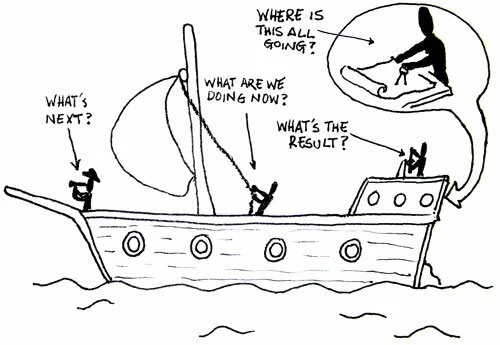
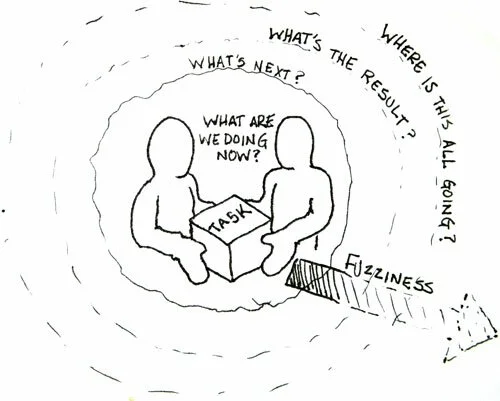
I stumbled upon a great book in my monthly Amazon book browsing (aka binge purchasing) called “Gamestorming: A playbook for Innovators,Rulebreakers, and Changemakers” by Dave Grey Sunni Brown and James Mancanufo.  It is a book written for business people looking to create change and inspire innovation in their organizations. In the introduction, the authors write about something called “fuzzy goals” that I would like to share and offer the suggestion to think about how it relates to education and in particular in teaching creative and critical thinking.


“Like Columbus, in order to move forward toward an uncertain future, you need to set a course. But how do you set a course when the destination is unknown? This is where it becomes necessary to imagine a world; a future world that is different from our own. Somehow we need to imagine a world that we can’t really fully conceive yet-a world that we can only see dimly through a fog.

In knowledge work we need our goals to be fuzzy. “ p. 5

I think what is happening with this creativity curriculum that is different from what a traditional art teacher might teach, is that the goals are not as precise, the way I ask my students to approach the challenges cannot be designed fully in advance, nor can they be fully predicted.


In education, we have this expectation of a “secure chain of cause and effect”, We use SMART goals. We lay out very detailed plans of how learning objectives will be achieved and map every detail out to the nth degree. However,  real true creative growth and innovation happens when a chain is not followed, but rather there is a framework for exploration, experimentation, and trial and error.  The same is true for retention of information. When I think about the bits of knowledge that have been exposed to over the course of my own school experience, those opportunities to connect the learning in a meaningful way through exploration, experimentation, and trial and error are the only ones that really stuck. 

Our purpose of education is not for kids to memorize and cram in information only to forget later after the project is complete or a test has been taken. We should provide spaces for them to create their own path and make connections that will last. (This thought came to me after participating in a conversation with some other teachers about how happy we should be about our standardized testing coming in the spring next year, rather than the fall, so that they information will be fresh and thus kids will score better.  And I wondered to myself, “Why are we even bothering to teach at all if we know and expect our kids to forget the information later?”)
 
In the real world and in life, the path to the goal is not clear, and the goal may in fact change.

In business, this is sometimes referred to as “sideways management”. 

A fuzzy goal is one that motivates the general direction of the work, without blinding the creator(s) to opportunities along the journey.

So, how does this happen?

According to Gamestorming:

“What’s the optimum level of fuzziness? To define a fuzzy goal you need a certain amount of ESP: fuzzy goals are Emotional, Sensory, and Progressive.

Emotional:  Fuzzy goals must be aligned with (students) passions and energy for their project. It’s this passion and energy that gives creative projects their momentum; therefore, fuzzy goals must have a compelling emotional component.

Sensory:  The more tangible you can make a goal, the easier it is to share with others. Sketches and crude physical models help to bring form to ideas that might otherwise be too vague to grasp. You may be able to visualize an effect of the goal, such as (the viewers experience).

Progressive:  Fuzzy goals are not static; they change over time. This is because, when you begin to move toward a fuzzy goal, you don’t know what you don’t know. The process of moving toward the goal is also a learning process, sometimes called successive approximation. As the (student) learns, the goals may change, so it’s important to stop every once in awhile and look around. Fuzzy goals may be adjusted and sometimes completely changed based on what you learn as you go.


(Students) need to navigate ambigious, uncertain, and often complex information spaces. What is unknown usually far outweighs what is known. In many ways it’s a journey in the fog, where case studies haven’t been written yet, and there are no examples of where it’s been done successfully before. Voyages of discovery involve greater risks and more failures along the way than other endeavors. But the rewards are worth it.” p.8

Sunday, October 20, 2013

Beginning the adventure

Hi, My name is September Buys.  I am a teacher in Greenville, Michigan. This is the very first post on my blog about a little experiment I'm conducting called "Creative Endeavors".  I've been meaning to set this up for some time now and now I've finally done it! I hope that people will share and comment on this project. Collaboration is vital to the success of this work.

The idea for the class started two springs ago. I was introduced to a book called "The Global Achievement Gap: Why even our best schools don't teach the new survival skills our children need - and what we can do about it" by Tony Wagner.

In it, he wrote about the seven skills schools need to be giving our kids in order to compete in our new creative economy.  I had heard our superintendent had given a copy of this very book to all of our building administrators. I began to think big (as I too often do, despite the self induced stress I cause when I do that) and I put together a little presentation to show the heads of our school.    I was proposing that we look at all of the research out there that is supporting these same ideas and make radical changes.  I was offering to serve as a "creativity coach" for the teachers in our district and help them learn how to teach creative problem solving skills. Here's a copy of my creative coach proposal.

Like a lot of my ideas, it was just too ambitious.  I received my figurative "pat on the head" and I returned to my art classroom.  It was about the same time that an "encore" or elective opening became available in our middle school. I'm not exaggerating when I say that I physically ran (ok, maybe quickly walked) down to my principal's office when she sent out an email asking for "suggestions on offerings for different kinds of classes".

I teach in a fairly large rural school district. When I started here in 2001, there were two art teaching positions for our 900+ 6th - 8th grade students.  Michigan, like many states, has had some economic struggles over the past decade and one of our art positions had been cut as a result.  As the only art teacher for some time, I found it frustrating that there were so many kids that wanted to have an art experience, but just couldn't fit it in their schedule.  I offered as much as I could, after school gifted programs, weekly art club meetings, private lessons, workshops for special populations (art therapy for the emotionally impaired, team teaching workshops for the cognitively impaired) during my lunch or planning time . But there was only one of me and over 900 of them.  What's an art teacher to do?

But now, there was an opening.  I knew asking for another art teacher wouldn't be enough.  My principal wanted "different" classes so that kids would have more options.  So, I thought, what if I focused on teaching creativity?  That can't be so hard, right?  I could use all of my research on creative education and experience teaching art to help me.  I could focus on idea development over skill development.  We could fill the position with a new art teacher to cover art history, art careers  and observational drawing. The proposal worked.

Welcome to my adventure.